


WHMIS 2015 (GHS) Online
WHMIS 2015 Online is based on the current 2015 legislation and meets the legislated requirement for general WHMIS training. Employers must also provide workplace-specific training and instruction for each of the hazardous products in the workplace.
WHMIS 2015 has come into effect with a transition period that lasts several years (full implementation by December 1, 2018). During this time, suppliers must fully comply with either WHMIS 2015 or with the “old” WHMIS (WHMIS 1988). This means that there may be hazardous products in the workplace that use WHMIS 2015 labels, classifications and Safety Data Sheets and there may be hazardous products that use WHMIS 1988 labels, classifications and (Material) Safety Data Sheets.
Duration
WHMIS Online is self-paced. Participants may leave the course at any time and can resume where they left off. The time required to complete the course will depend on many factors including the participant’s learning style and their prior knowledge of course material. Most participants will complete WHMIS Online in less than 2 hours.
Learning Objectives:
Upon completion of WHMIS 2015 (GHS) online, participants will be able to:
- Understand the essential role WHMIS plays in protecting the health and safety of Canadian workers
- Identify the WHMIS responsibilities of suppliers, employers, and workers
- Know the workplace requirements related to the use of supplier labels and workplace labels, and how to locate and interpret the information found on these labels
- Recognize the WHMIS pictograms and the types of hazard each represents
- Recognize the Safety Data Sheet (SDS) as a source of comprehensive information about a hazardous chemical in the workplace and know how to locate various types of information when reading an SDS
- Identify the WHMIS exemptions for suppliers and importers
- Know general safe work practices that should be followed when working with hazardous products
WHMIS Online is an active learning experience, using interactive content screens and online exercises to engage learners and reinforce key concepts. Mandatory testing ensures that participants have met learning objectives and retained the required knowledge.
Evaluation Process:
No participant can complete the course without verifying their understanding of the course material. WHMIS 2015 (GHS) online is presented in 6 modules. To progress from one module to the next, participants must pass a mandatory test. Those who do not pass the test must review the module content and re-test. There is no limit to the number of re-tests. Test questions are randomly selected from a test bank to ensure that re-tests will be unique.
How to register?
Please select how many you would like to purchase and pay for the course by adding to your cart. Once payment is received you will receive an email within 24hrs from the Red Cross with your login code(s). Please makes sure we receive email addresses for everyone enrolled into the program with first and last name. This will ensure everyone is getting login codes.
When successfully completed you will receive an electronic certificate of completion.

Transportation of Dangerous Goods (TDG)
In the Transportation of Dangerous Goods (TDG) course you will learn its regulations and proper training, proper documentation, safety marks and means of containment, forbidden goods, exemptions and special provisions as well as, immediate reporting and procedures to follow in the event of an emergency.
Also Please Note: Although this is a nationally recognized course, if you are currently unemployed and seeking employment it is up to your new employer to accept any prior training. They may still require you to re-train once hired.
Duration
This online course is self-paced. Participants may leave the course at anytime and can resume where they left off. The duration will depend on the individual participant and their prior knowledge of the subject matter. On average, the course will take between 5 – 9 hours to complete.
Learning Objectives:
Ultimately, the goal of this course is to provide participants with the information they need to comply with the TDG Act and regulations. By completing this course, they should know how dangerous goods are classified; understand the regulations pertaining to proper documentation, safety marks, means of containment, forbidden goods, exemptions and special provisions; and know the immediate reporting and procedures to follow in the event of an emergency involving dangerous goods.
This course is presented in 9 modules:
- Introduction to TDG
- Regulations and Training
- Classification of Dangerous Goods
- Safety Marks Used in Conjunction with Dangerous Goods
- Means of Containment
- Documentation
- Forbidden Goods, Exemptions and Special Provisions
- Exemptions
- Immediate Reporting and ERAPs
Evaluation Process:
At the end of each module, there is a test. Participants that do not achieve 100% can review the module content and try as many times as necessary to complete the course. Test questions are randomly selected from a test bank, making each test unique.
How to register?
Please select how many you would like to purchase and pay for the course by adding to your cart. Once payment is received you will receive an email within 24hrs from the Red Cross with your login code(s). Please makes sure we receive email addresses for everyone enrolled into the program with first and last name. This will ensure everyone is getting login codes.
When successfully completed you will receive an electronic certificate of completion.

Medical Terminology
The Medical Terminology course provides an introduction to the professional language used by those who are directly and indirectly involved with the art of healing. The course will also introduce those not currently involved in the health care environment with an introduction to the language of medicine. In addition, the program will provide participants with the basics of human anatomy and physiology.
Duration
This online course is self-paced. Participants may leave the course at anytime and can resume where they left off. The duration will depend on the individual participant and their prior knowledge of the subject matter. On average, the course will take between 12 – 24 hours to complete.
Course Content
- Introduction to Medical Terminology
- Body Structures
- Word Parts
- Integumentary System
- The Breast
- Musculoskeletal System
- Nervous System
- The Sensory System
- Cardiovascular System
- Lymphatic and Immune System
- Respiratory System
- Digestive System
- The Endocrine System
- Reproductive System
- Urinary System
Evaluation Process:
At the end of each module, there is a test. Participants that do not achieve 70% can review the module content and try as many times as necessary to complete the course. Test questions are randomly selected from a test bank, making each test unique.
How to register?
Please select how many you would like to purchase and pay for the course by adding to your cart. Once payment is received you will receive an email within 24hrs from the Red Cross with your login code(s). Please makes sure we receive email addresses for everyone enrolled into the program with first and last name. This will ensure everyone is getting login codes.
When successfully completed you will receive an electronic certificate of completion.

Lockout / Tagout
The term “Lockout/Tagout” refers to specific practices and procedures to safeguard workers from the unexpected energizing or start-up of machinery and equipment, or the release of hazardous energy during service or maintenance activities. Lockout/Tagout explains the importance of Lockout/Tagout in protecting the health and safety of workers. The course examines basic workplace safety tenets and examines the specific stages and procedures of the Lockout/Tagout process. The basic tenets of safety are explained as are the specific stages and procedures of the Lockout-Tagout process.
Duration
This online course is self-paced. Participants may leave the course at anytime and can resume where they left off. The duration will depend on the individual participant and their prior knowledge of the subject matter. On average, the course will take between 1.5 – 3 hours to complete.
Learning Objectives:
Ultimately, the goal of this course is to educate participants as to what a lockout device is and when Lockout-Tagout should be used in the work place. The course examines basic workplace safety tenets and examines the specific stages and procedures of the Lockout-Tagout process.
This course is presented in 4 modules:
- Introduction
- Injury Prevention
- Equipment Shutdown and Isolation
- The Procedure of Lockout – Tagout
Evaluation Process:
At the end of each module, there is a test. Participants that do not achieve 100% can review the module content and try as many times as necessary to complete the course. Test questions are randomly selected from a test bank, making each test unique.
How to register?
Please select how many you would like to purchase and pay for the course by adding to your cart. Once payment is received you will receive an email within 24hrs from the Red Cross with your login code(s). Please makes sure we receive email addresses for everyone enrolled into the program with first and last name. This will ensure everyone is getting login codes.
When successfully completed you will receive an electronic certificate of completion.

Fire Safety
No one expects a fire, emergency or other disaster to occur in their workplace. It is important to remember that these misfortunes can strike anyone, anytime, and in any workplace. Fires in the workplace cause extensive injury and property loss. If a fire started in your home or workplace would you know what to do?
Fire Safety teaches participants about the legislated fire safety responsibilities of the employer and the worker, describes safe work practices related to fire prevention, and provides practical information about emergency response in situations involving fire.
Course Duration:
This online course is self-paced. Participants may leave the course at anytime and can resume where they left off. The duration will depend on the individual participant and their prior knowledge of the subject matter. On average, the timeline for completion will be 1 – 2 hours.
Course Objectives:
Upon completion of the course, participants should be able to:
- Explain how the issue of fire safety is addressed by occupational health and safety (OHS) legislation in Canada and identify the fire safety responsibilities of employers and those of workers
- Describe safe work practices that can reduce the risk of fire
- Know what to do in the event of a fire
- Recognize fire-related situations in which the use of a fire extinguisher is appropriate and situations in which it is best to evacuate rather than try to put out the fire
- Identify the types of extinguishers, and the classes of fire that can be put out using each type of extinguisher
- Know how to use a fire extinguisher
- Understand the maintenance and servicing requirements related to fire extinguishers
Evaluation Process:
Fire Safety is a 4-module course. At the end of each module, there is a test. Participants must successfully complete the test before continuing to the next module. Participants that do not achieve 100% can review the module content and try as many times as necessary to advance and complete the course. Test questions are randomly selected from a test bank, making each test unique. Upon successfully completing all modules, there is a printable certificate for your records.
How to register?
Please select how many you would like to purchase and pay for the course by adding to your cart. Once payment is received you will receive an email within 24hrs from the Red Cross with your login code(s). Please makes sure we receive email addresses for everyone enrolled into the program with first and last name. This will ensure everyone is getting login codes.
When successfully completed you will receive an electronic certificate of completion.

Bloodborne Pathogens
This program is designed for individuals who may be exposed to blood and body fluids or items contaminated with blood during the performance of their work. This program will give anyone a basic understanding of blood-borne pathogens.
Duration:
This online course is self-paced. Participants may leave the course at anytime and can resume where they left off. The duration will depend on the individual participant and their prior knowledge of the subject matter. On average, the course will take between 3 – 4 hours to complete..
Course Objectives:
The purpose of this course is to provide participants with the basic ability to recognize the hazards associated with occupational exposure to blood and body fluids; be familiar with the steps to prevent exposure to bloodborne pathogens; and to know the steps that should be taken following exposure to blood and body fluids.
The course is presented in 4 modules:
- Introduction to Bloodborne Pathogens
- Bloodborne Pathogen Regulations
- Workplace Programs and Personal Protection
- Bloodborne Pathogen Exposure Follow-up
How to register?
Please select how many you would like to purchase and pay for the course by adding to your cart. Once payment is received you will receive an email within 24hrs from the Red Cross with your login code(s). Please makes sure we receive email addresses for everyone enrolled into the program with first and last name. This will ensure everyone is getting login codes.
When successfully completed you will receive an electronic certificate of completion.

Red Cross First Aid for Opioid Poisoning (online)
poster-ohr-signs-opioidpoisoning-en-2024
Online information on how to deal with Opioid overdoses and how to use the Naloxone (Narcan) kit.
This is new program from the Red Cross.

In the First Aid for Opioid Poisoning online course, you will become knowledgeable and confident in how to respond to an opioid poisoning emergency, including how to administer intranasal and intramuscular naloxone.
What will you learn?
- You will learn to recognize the signs and symptoms of opioid poisoning.
- What naloxone is and how naloxone works to reverse an opioid poisoning.
- Understand how opioids and naloxone affect the body.
- Explore ways to reduce the influence of stigma around opioid poisoning.
- Learn how to respond confidently to an opioid poisoning emergency.
- How to administer intranasal and intramuscular naloxone.
Who should take the First Aid for Opioid Poisoning course?
Anyone 16 years of age and older. This course has no prerequisites.
poster-ohr-care-opioidpoisoning-en-2024
Canadian Red Cross Online-Based Learning
- Self-directed: Learn at your own pace by working through the training materials online.
- Duration: Approximately 1 hour online.
- Knowledge check on each module: You will need to pass the test at the end of each module with a score of at least 70%. You will be able to review the module content and try as many times as necessary to complete the course.
Advance your career with a certification
- Successfully completing the course will earn you a Red Cross certificate of completion of First Aid for Opioid Poisoning.
For any questions or like to book a workshop for your company, please contact us.
Please visit Canadian Red Cross for the latest developments.
Fall protection
Fall protection hierarchy
The fall protection hierarchy must be used when choosing methods to eliminate or control fall hazards. The steps are listed in the order in which they should be considered.
-
Guardrails
Where fall hazards cannot be eliminated, permanent or temporary guardrails or handrails form a protective barrier around an opening or edge to prevent a fall to a lower level.
-
Fall restraint
After eliminating fall hazards and installing guardrails, a fall restraint system is the next level in the fall protection hierarchy.
Fall restraint systems prevent you from falling through either travel restriction or work positioning. With travel restriction, workers are attached to a fixed-length line that prevents them from travelling to close to an opening or edge.
-
Fall arrest
When it’s not possible or practical to use a fall restraint system, the next line of protection is fall arrest.
A fall arrest system (including a lanyard or lifeline, a harness, and, most importantly, an anchor) protects you after a fall by stopping you from hitting the surface below
-
Work procedures
If guardrails, fall restraint, or fall arrest are not practicable, or will result in greater risk of injury, contact the Prevention Information Line to discuss alternative safe work procedures that are acceptable to WorkSafeBC.
Red Cross Basic Life Support (formerly called CPR-HCP)
Red Cross Basic Life Support (formerly called CPR-HCP)
Duration
- Stand-alone course – 4 hours
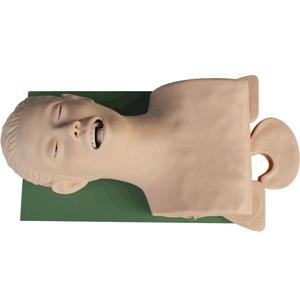
- With Airway Management – 5 hours
- With Oxygen Therapy – 5 hours
- With Airway Management and Oxygen Therapy – 6 hours
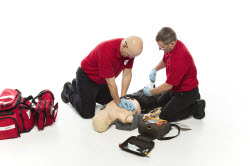
Designed to build participant confidence in performing cardiopulmonary resuscitation (CPR) skills and provide the important steps to perform a rapid assessment, perform Basic Life Support (BLS) skills, and perform rapid defibrillation. Airway Management and Oxygen Therapy can also be added as additional certifications to this course.
Audience
In-facility care providers, including nursing staff, care aides, medical and dental professionals. Pre-hospital care providers, which may include professionals in a fire service, rescue team, sports-medicine, lifeguards and ski patrol.
Prerequisites
None
Airway Management
Scheduling
Afternoon/Evening program (if offered) – please look at the times below
Day Program (if offered) – please look at the times below
For Oxygen and Airway Management its up to 1 hr extra per module.
***Basic Life Support (formerly called CPR-HCP) is a 1 year certification, recertifying your BLS course is 2 hrs for the basic course.***
This course can be combined with most standard Red Cross courses, like Standard First Aid or Emergency first aid. To book your class, please visit our course listing: https://be-prepared.ca/courses-abbotsford-richmond/
***WHEN SCHEDULING YOUR RECERTIFICATION, PLEASE BRING PROOF OF CURRENT CERTIFICATE, IF TICKET HAS EXPIRED (EVEN FOR A DAY), PLEASE SCHEDULE FOR FULL COURSE!! – THESE ARE RED CROSS STANDARDS***
For more information, please visit the Red Cross link below:
Incident Investigations (JHSC)
Incidents requiring an investigation
Employers are responsible for immediately conducting an investigation into any incident that involves:
Serious injury to a worker or a worker’s death.
Injury requiring medical treatment.
Minor injury, or no injury, but had the potential for causing serious injury.
Major structural failure or collapse.
Major release of hazardous substances.
Diving incident, as defined by the Occupational Health and Safety (OHS) Regulation.
Dangerous incident involving explosive materials.
Blasting incident causing personal injury.
Section 173 of the Workers Compensation Act provides more details about what incidents employers must investigate.
Investigation stages
Conducting an investigation into an incident that occurred in your workplace includes four stages. Those conducting the investigation must be knowledgeable about the type of work involved at the time of the incident. An employer and a worker representative must participate, if or as they are available.
The four stages of an investigation are:
1. Preliminary investigation
A preliminary investigation is an opportunity for employers to identify any unsafe conditions, acts, or procedures that must be addressed. This will lead to the point where work can resume safely at least until a full investigation has been completed. Employers must complete a preliminary investigation and accompanying report within 48 hours of an incident.
2. Interim corrective actions
During the period between the incident and the conclusion of the full investigation, an employer is responsible for taking all actions reasonably necessary to prevent the incident from happening again.
If you can identify only some of the unsafe conditions, acts, or procedures that significantly contributed to the incident? The employer will have to take interim corrective actions. This may include a full or partial shutdown of the worksite.
Other action may be removal of equipment, or reassignment of workers to other duties.
3. Full investigation
A full investigation is about determining an incident’s cause or causes. This involves carefully analyzing the facts and circumstances. That will identify the underlying factors that led to the incident. Key questions to ask include:
- What factors made the unsafe conditions, act, or procedures possible?
- Are there any health and safety deficiencies in my management system or processes?
A full investigation and report must be completed within 30 days of the incident.
4. Final corrective actions
Once a full investigation has been completed, as an employer you must prepare a corrective action report. This will describe the unsafe conditions that led to the incident. Also what corrective action is necessary. But more important what steps you and your organization will take to implement those actions.
Incident investigations for Joint Health and Safety Committee will be a necessary and great course to offer to the committee members.
If you would like more information about scheduling this course for your company, please fill out our contact form.